
 3 years ago
1
3 years ago
1
ARTICLE AD BOX
An electronic ticker at the Philippine Stock Exchange (PSE), operated by Philippine Stock Exchange Inc., in Taguig, the Philippines, on Friday, June 24, 2022. The exchange will permanently close its trading floor after the pandemic hastened its migration to "floorless trading" amid a digital shift that's changing the operations of capital markets. Photographer: Veejay Villafranca/Bloomberg

Continuing US jobless claims rose to the highest since early February, suggesting that Americans who are losing their job are having more trouble finding a new one. Traders are now waiting Friday’s producer price index for November — one of the final pieces of data Fed policymakers will see before their Dec. 13-14 policy meeting. The PPI in October cooled more than expected.
“It’s interesting to see jobless claims rising slightly, but in all likelihood this won’t move the market needle too much,” said Mike Loewengart at Morgan Stanley Global Investment Office. “Investors will have a lot to digest these next few days as they get a clearer picture of where we stand in the fight against inflation before the Fed decision. The market is largely expecting the slowdown in rate hikes to begin next week, but whether the pivot will be enough to steer the economy into a soft landing remains the question.”
Read: Fed Gets a Win Deflating Asset Bubbles Without Financial Crash
Strategists from Morgan Stanley to JPMorgan Chase & Co. have warned investors against piling back into risk on hopes the Fed is getting close to pivoting to easier policy.
“Presumably if the Fed is pivoting this time around, it’s not for a good reason. It’s a deteriorating fundamental picture,” Joyce Chang, chair of global research at JPMorgan, told Bloomberg Television. “I mean, is that really a reason to be buying risk? I think it’s premature to say that there is a Fed pivot.”
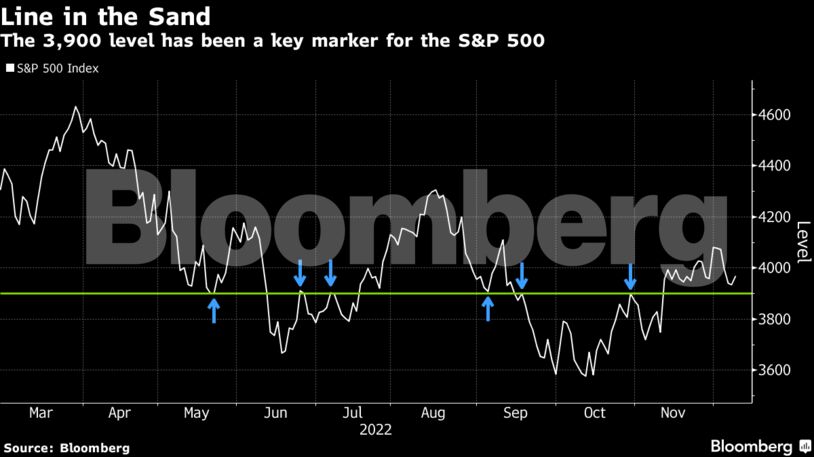
Besides the 100-day moving average, the S&P 500 is trading near a key support at 3,900, a level that has provided the pivot point for reversals on multiple occasions this year.
As the equity market rebounded, the Cboe Volatility Index fell to around 23. Yet derivatives strategists at JPMorgan Chase & Co. say the VIX has further room to advance.
They expect the fear gauge to average at 25 next year, and see the gauge trading above that level in the first half of the year amid elevated monetary-policy concern before subsiding below the line in the latter part of 2023 when the central bank is expected to pivot its stance.
Read: S&P Faces Bumpy Road After Sliding Below Key Level From October
Key events this week:
- US PPI, wholesale inventories, University of Michigan consumer sentiment, Friday.
Some of the main moves in markets:
Stocks
- The S&P 500 rose 0.9% as of 10:31 a.m. New York time
- The Nasdaq 100 rose 1.1%
- The Dow Jones Industrial Average rose 0.8%
- The Stoxx Europe 600 was little changed
- The MSCI World index rose 0.8%
Currencies
- The Bloomberg Dollar Spot Index fell 0.3%
- The euro rose 0.4% to $1.0544
- The British pound rose 0.3% to $1.2234
- The Japanese yen rose 0.2% to 136.39 per dollar
Cryptocurrencies
- Bitcoin rose 0.6% to $16,923.54
- Ether rose 1.4% to $1,248.98
Bonds
- The yield on 10-year Treasuries advanced four basis points to 3.46%
- Germany’s 10-year yield advanced three basis points to 1.81%
- Britain’s 10-year yield advanced two basis points to 3.07%
Commodities
- West Texas Intermediate crude rose 1.3% to $72.98 a barrel
- Gold futures rose 0.5% to $1,806.20 an ounce
This story was produced with the assistance of Bloomberg Automation.





 English (US)