
 3 years ago
1
3 years ago
1
ARTICLE AD BOX
Price review
- Takealot now sells more of other businesses' products than their own.
- They do this through Takealot Marketplace, which charges sellers fees to list and sell items on their platform.
- Sellers must pay various fees to tap into Takealot's tools and logistics and its claimed 3 million shoppers.
- Selling a typical paperback novel will cost you around R90, or an off-brand cellphone charger about R70, in success and fulfilment fees alone.
- You may also have to pay for storage, some penalties, and transport to Takealot's distribution centres in Joburg and Pretoria.
- For more stories, go to www.BusinessInsider.co.za
South Africa's largest online retailer Takealot started as a traditional retail store, selling products it sourced directly, and stored privately, to the general public.
In 2015, it updated its business model to keep pace with global online stores, allowing third-party sellers to use its marketplace solution platform to sell products.
To the casual shopper, it had little impact on the experience, and many may still not have realised most of their products aren't coming from Takaelot, but from various small businesses.
For customers, it was mostly a positive move; it meant the range of products available on Takealot had increased, along with some pricing competition on popular items.
It wasn't an original idea .Amazon launched their own product, called Amazon Marketplace, in 2000. And although at the time founder Jeff Bezos faced criticism, when he stepped down as CEO 21 years later, Amazon Marketplace was generating a fortune for the company.
Marketplaces as online store cash cows
Reports at the time suggested that Amazon's third-party marketplace may have generated operating profits of $24 billion - much of which arrived in the form of seller fees and fulfilment costs.
It was, therefore, unsurprising that Takealot followed the global online marketplace trend - and has since benefited significantly.
Despite posting a loss of R223 million in the six months to end-September last year, on releasing these results, Takealot said its third-party marketplace sales continued to outpace first-party sales.
In 2022, these marketplace sales accounted for 52% of Takealot's total gross merchandise value - and they're expected to continue growing.
Not without criticism
These profits come directly from small business owners who make marginal profits on sometimes risky endeavours. Takealot charges a monthly platform fee plus success fees when products sell, storage fees if they don't sell fast enough, and penalties if they run out of stock.
Without caution, some sellers may pay in on their items due to associated fees.
Most global online marketplaces tout themselves as mutually beneficial platforms for small businesses - but they've faced criticism. Some have accused Amazon of squeezing third-party marketplace sellers to increase its profits.
And similar criticism exists of Takealot's Marketplace, in closed Facebook groups, on YouTube, HelloPeter, and, most notably, in a 2022 Competition Commission inquiry.
Voluntary platform with (mostly) transparent fees
Still, participation on the platform is voluntary, and Takealot clearly states most of its fees on its seller platform website. Some fees, particularly penalties, don't reside on their seller page - but in a 4,000-word service level agreement seen by Business Insider SA.
The seller journey is designed to be mutually beneficial. Takealot benefits more if marketplace products sell. It does, however, attract several fees at various points that will eat into sellers' profits.
The first expense sellers encounter on Takealot Marketplace is a flat-rate subscription fee. This monthly subscription costs R460 - regardless of whether or not you're making money.
Many of the subsequent fees are percentage-based, which is where it gets a bit complicated.
Takealot charges Marketplace sellers percentage-based fees depending on the product category, which vary according to the specific product. At a minimum, you'll pay 4% if your product sells. Maximum fees scale up to 18%.
Fees also scale fees according to the package size - and how long it sits in Takealot's warehouse.
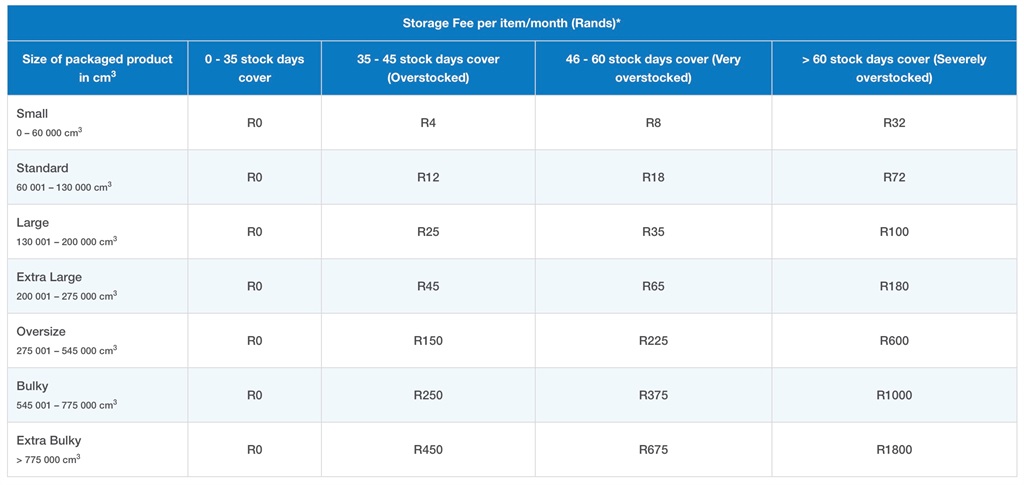
Table of Takealot storage fees. Image: Takealot.com
This makes estimating an exact fee you'll pay for your products difficult - and puts pressure on you to only sell products you expect will move through their system fast.
Here are some examples of success and fulfilment fees for common items you'll find for sale on Takealot Marketplace:
- An average size paperback book that you're selling for R300
You'll likely pay Takealot R48.30 in success fees and R41.40 in fulfilment fees - a total of R89.70.
This leaves you with R210.30 to cover the book's wholesale cost and other expenses, and make a profit.
- A 6-litre air fryer that you're selling for R1,500
You'll likely pay Takealot R172.50 in success fees and R52.90 in fulfilment fees - a total of R225.40.
This leaves you with R1,327.50 to cover the air fryer's wholesale cost and other expenses, and make a profit.
- An off-brand iPhone charger and cable for R200
You'll likely pay Takealot R32.20 in success fees and R34.50 in fulfilment fees - a total of R66.70.
This leaves you with R133.30 to cover the wholesale cost of the product and other expenses, and make a profit.
- A budget three-piece luggage set for R1,500
Takealot charges sellers a high success fee for luggage. For a three-piece set costing just R1,500, you'll likely pay around R258.75 in success fees, and R57.50 in fulfilment fees.
This leaves you with R1,183.75 to cover the wholesale cost of the product and other expenses, and make a profit.
Success and fulfilment fees are only part of the story
The above figures serve as an estimation only, using Takealot's online fees estimator. And there are several other Takealot fees to consider.
Aside from the R460 monthly flat membership fee, you may need to pay storage fees.

Table of Takealot fulfilment fees. Image: Takealot.com
Takealot doesn't charge sellers for the first 35 stock days, so fast-selling items incur no storage fee. But if your product doesn't sell within the first month, you could be in for anything from R4.60 to R2,070 in storage fees, including VAT, for every subsequent month, depending on your product's size and how long it spends in the Takealot warehouse.
Table of Takealot storage fees. Image: Takealot.com
Takealot also charges sellers penalty fees for certain transgressions, like a R75 fee for items being out of stock or late.
And you'll also need to cover the cost of shipping your product to the Takealot distribution centres - usually to those in both Johannesburg and Cape Town.
For this reason, many sellers group items and send them to distribution centres in bulk to save on paying for individual shipping costs.
Social media and online courses
Given the potential pitfalls, a growing community of local social media users and YouTubers have created platforms to sing the virtues of making money on Takealot Marketplace - and then, ironically, attempt to sell courses on how to succeed.
Takealot Marketplace self-help courses have popped up across the internet - and even on the platform itself.
And yet, despite the costs and complexities of selling on Takealot Marketplace, its dominance in the local market makes it a compelling outlet for many small businesses that can juggle the logistics and fees carefully.
* Business Insider South Africa is part of 24.com, a division of Media24, which is a subsidiary of Naspers. Takealot is a Naspers business.







 English (US)