
 3 years ago
1
3 years ago
1
ARTICLE AD BOX
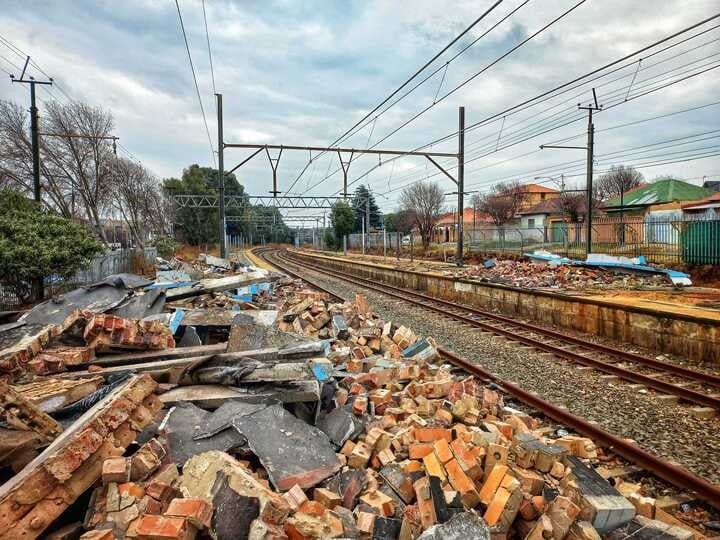
The remains of the Grosvenor station in Johannesburg South. (
News analysis
- South Africa has a new National Land Transport Strategic Framework, a five-year planning document for road and rail.
- It is, in every important respect, unchanged from the strategic framework adopted in 2017.
- The major problems identified back then all persist today, by government's own reckoning.
- But there is no intent to change the strategy – beyond deleting a couple of measurable targets.
- For more financial news, go to the News24 Business front page.
In 2017, the Department of Transport provided a grim assessment of the "current realities" of road and rail in South Africa. Vast amounts of money had not fixed public transport. Eighty-eight per cent of freight was being moved by road instead of rail. Road fatality numbers were horrifically high. Other than national roads, road and rail maintenance was terrible. Pedestrians and cyclists were not being catered for in new developments.
Last week, the department provided a brand new assessment of the state of road and rail in South Africa. One thing had changed in the intervening five years: the fraction of freight being moved by road was down to 87%.
In the next five years, said the department, it will get to grips with those problems – using a big-picture plan that is in every notable respect identical to the one it adopted in 2017.
The assessment, and the plan, are contained in the National Land Transport Strategic Framework, which the Department of Transport published for 30 days of comment. By law, that document must be updated every five years, to better guide transport planning by national government, provinces, and local governments. It provides a basis on which the Department of Transport can hold municipalities to account, and contains key performance measures on which the Department of Transport itself can be evaluated.
But other than a snazzy new cover, the 2023 to 2028 draft is nothing but a thinly edited version of the 2017 to 2022 edition.
In 2017, the framework noted that there were a lot of private cars on South Africa's roads. In 2023, it adds that the level of private car use is unsustainable.
In 2017, one of the problems identified with public transport was "accessibility". In 2023, that has been updated to "universal accessibility".
Perhaps the most damning part of the assessment remains exactly the same since 2017: "A lack of institutional and management capacity is one of the most substantial short-term obstacles in achieving the policy objectives for transport."
Also unchanged is what comes down to a prediction about the future of transportation in South Africa: "The current policy and fragmented transport systems are not feasible and not sustainable."
That may be bad news for anyone using roads and rail but, if the draft document is adopted in its current form, the next five years will be slightly easier for the Department of Transport.
In 2017, the strategy had set a handful of hard, measurable targets. Some of those did not make it into the new version. Gone is the plan to ensure that every rural pupil should be able to get to school within an hour, replaced by a key performance metric that is simply to "[i]mprove access to learner transport services". Gone is a plan to measure how long trips on rural public transport take, and how much they cost, as well as an implied promise to make all forms of transport both faster and cheaper.
Still, by prioritising the right things today, the strategy can "create a firm foundation" on which to develop an efficient transport system, the document says. Just as its predecessor did in 2017.





 English (US)