
 3 years ago
2
3 years ago
2
ARTICLE AD BOX
- Civilians say army factions in Sudan are fighting over access to resources and corruption.
- The US and UK say the first priority is the safety of civilians.
- Aid agencies say the fighting has crippled operations.
In African folklore there's an adage that goes: "When elephants fight, it's the grass that suffers."
This can be applied to the crisis in Sudan in which the military coalition is engaged in gun battles and the ordinary people are affected the most.
By the end of Monday, according to NGO Human Rights Watch (HRW), the clash between the Sudan Armed Forces (SAF) and the Rapid Support Forces (RSF), an independent military force, was responsible for 100 civilian deaths.
EXPLAINER | What is behind the recent military clashes in Sudan?
When fighting of such a magnitude erupts, countries that have embassies stationed in conflict zones put the safety of their citizens first.
US Secretary of State Antony Blinken, joined by UK Foreign Secretary James Cleverly, said at a press conference they were worried about the threat the conflict posed for civilians.
They added that they had activated a diplomatic offensive to ensure civilians' safety.
"We have been consulting very closely on the situation in Sudan. We've also been in close touch with partners in the Arab world, in Africa, and in international organisations.
Blinken said:
There is a shared deep concern about the fighting, the violence that's going on in Sudan; the threat that poses to civilians, that it poses to the Sudanese nation, and potentially poses even to the region.
So far, three World Food Programme (WFP) employees were reportedly killed and an aircraft belonging to the aid agency was also destroyed during gunfire at the airport in the capital city of Khartoum.
For the UK and US, a return to negotiations that will usher in civilian rule and the safety of the people is at the heart of their concerns.
"There is also a very strong shared view about the need for Generals [Abdel Fattah] al Burhan and [Mohamed Hamdan Dagalo aka] Hemedti to ensure the protection of civilians and non-combatants, as well as people from third countries, including our personnel who are located in Sudan; and also a strongly held view – again, across all of our partners – on the need for an immediate ceasefire and a return to talks, talks that were very promising in putting Sudan on the path to a full transition to civilian-led government," Blinken added.
The UK has since issued an advisory note for its nationals, warning them against travelling to Sudan because their safety ahead of anything else is a top priority.
"Obviously, from the UK government's point of view, our first priority is the protection of British nationals. We have previously changed travel advice and advised against travel to Sudan. I've ensured that the British officials at the embassy in Khartoum are safe and accounted for, and we will continue to provide what support we can to British nationals in Sudan," Cleverly said.
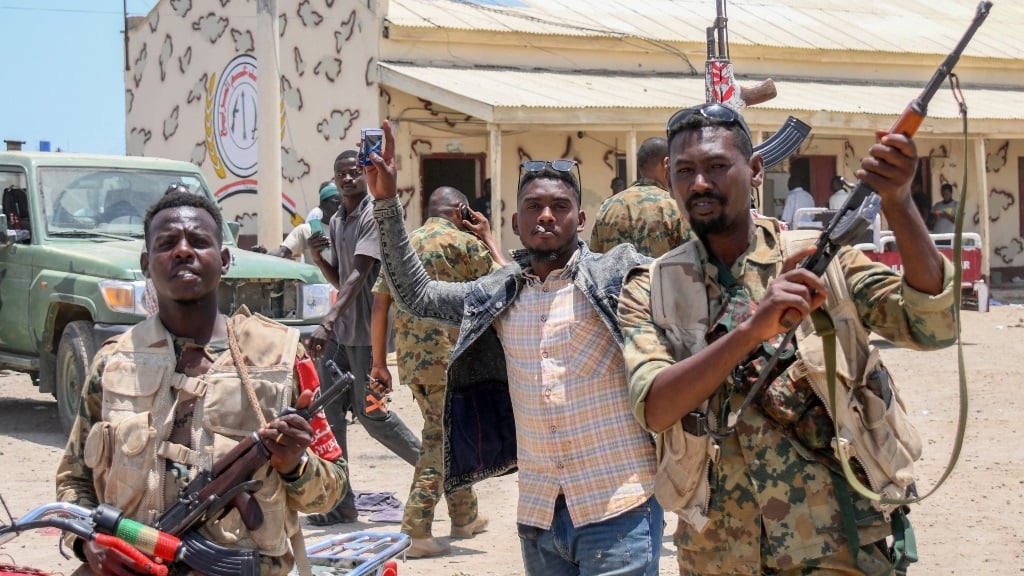
Sudanese army soldiers, loyal to army chief Abdel Fattah al-Burhan, pose for a picture at the Rapid Support Forces (RSF) base in the Red Sea city of Port Sudan.
AFP AFP
Kurt Tjossem, the regional vice-president for East Africa at the International Rescue Committee (IRC), said humanitarian work in a country that depends on it so much has been affected.
"Conflict has disrupted humanitarian action where over a third of the population, an estimated 15 million people, including refugees, are experiencing acute food insecurity," he said.
The IRC has since abandoned the majority of its operations in Sudan with only the Tunaydbah camp, which also houses refugees from Ethiopia who just came out of the devastating Tigray conflict, still operational.
Save The Children claimed its medical supplies, refrigerators and cars were looted or stolen as the fighting raged on.
As such, the aid agency was failing to deliver its supplies to war-affected areas, particularly in the northern parts of Darfur.
Doctors Without Borders (MSF) said by the end of Tuesday, it has taken in 136 wounded patients at the hospital it supports in El Fasher, North Darfur. Of those, 11 have died of their injuries.
Cyrus Paye, project coordinator for MSF in El Fasher said in a statement: "The hospital is rapidly running out of medical supplies to treat survivors. It is running out of medicines and blood. There has also been a power outage in the city since the beginning of the fighting, and fuel supplies for the hospital generator are also running low.
"We have received a list of surgical items that the surgical team urgently requires and we are seeking a safe corridor in order to transport these to the hospital using our two ambulances. Due to the conflict, the airport has been closed since Saturday, and it is vital that it is reopened so that we can bring in additional medical supplies and possibly, an MSF surgical team to support the surgeons who are currently at work. Without these vital supplies, there will be further loss of life."
The Turkish Radio and Television Corporation (TRT) interviewed a civilian in Sudan who said the fight between the two military factions had nothing to do with democracy, justice or anything close to a rules-based world. It was about access to resources and looting.
The person said:
They are fighting over who has authority over looting the country and the people, but we are fighting for food, water, education, and health services, which they haven't provided.
HRW's man in the region, Mohamed Osman, said the fight between the SAF and RSF was a clear message that the people's voice and aspirations in Sudan were not regarded.
"Sudan's military leaders are again showing utter disregard for the hopes and rights of the Sudanese people," he said.
Osman also placed the blame on the international community's failure to reign in the junta in Sudan when there was time to do so.
"The failure of international actors to put any serious pressure on abusive leaders has continued to embolden them," he said, adding that it was the best time for the world to act and save the face of democracy and civilian politics.
De facto Sudanese President General Abdel Fattah al Burhan said he was open to discussions, but the volatile situation was not conducive to intervention from neighbouring countries.
The News24 Africa Desk is supported by the Hanns Seidel Foundation. The stories produced through the Africa Desk and the opinions and statements that may be contained herein do not reflect those of the Hanns Seidel Foundation.




 English (US)